Friday, December 09, 2011

Lamp to the Path of Enlightenment Part 4

(32) If you train yourself well in the three
trainings of ethical discipline
By living in accord with the vows
that are the very nature of engaged bodhichitta
And which are a cause for purifying completely
your body, speech, and mind,
Your respect for the three trainings in ethical
discipline will increase.

(33) Through this (will come) the completely
purified, full state of enlightenment;
For, by exerting yourself in the vows of the
bodhisattva vows, You will fully complete the
networks needed For total enlightenment.

(34) As for the cause that will fully complete
these networks Having the nature of positive
force and deep awareness, All the Buddhas have
asserted that it is The development of advanced
awareness.

(35) Just as a bird without fully developed wings
Cannot fly in the sky,
Likewise lacking the force of advanced awareness,
You will be unable to fulfill the aims of
limited beings.

(36) Whatever positive force is had in a day
and a night By someone possessing advanced
awareness Is not had even in a hundred lifetimes
By someone lacking advanced awareness.

(37) Therefore, if you would wish to fully complete,
Quickly, the networks for total enlightenment,
Make effort and thereby come to attain
Advanced awareness. It is not to be had by the lazy.

(38) Someone who has not achieved a stilled settled
mind Will not attain advanced awareness.
Therefore, repeatedly exert effort
To actualize a stilled settled mind.

(39) However, should the factors for a stilled
settled mind be weak, Then even if you have meditated
with great effort
And even if for thousands of years,
You will not attain single-minded concentration.

(40) Therefore, maintain well the factors mentioned
In the chapter on A Network for Single-Minded
Concentration. Then place your mind on something
constructive: Namely one of the appropriate
objects of focus.

(41) When a yogi actualizes a stilled settled mind,
He or she attains as well advanced awareness.
Training in Higher Discriminating Awareness
However, if you have failed to apply yourself
to far-reaching discriminating awareness,
You will be unable to deplete the obscurations.

(42) Therefore, in order to rid yourself of all
obscurations, without exception, Regarding the
disturbing emotions and knowable phenomena,
Always meditate on the yoga of far-reaching
discriminating awareness Together with methods.

(43) This is because discriminating awareness
lacking methods As well as methods lacking
discriminating awareness
Have been said still to be bondage.
Therefore, never abandon having both.

(44) To get rid of doubts concerning
What is discriminating awareness and what
are methods, I shall clarify the actual division
Between methods and discriminating awareness.

(45) The Triumphant One has explained that
Leaving aside far-reaching discriminating awareness,
All networks of constructive factors,
Such as far-reaching generosity and so forth,
are the methods.

Thursday, December 08, 2011

Lamp to the Path of Enlightenment Part 3

(21) As for the seven classes for individual liberation,
The Accordingly Progressed has asserted in his explanations
That those of glorious abstinence are supreme;
And those are the vows for fully ordained monks.

(22) Through the ritual well expounded in
Take the (bodhisattva) vows
From an excellent, fully qualified guru.

(23) Know that an excellent guru is someone who
Is skilled in the vow ceremony,
By nature lives by the vows,
Has the confidence to confer the vows,
and possesses compassion.

(24) However, if you have made effort in this
And have been unable to find such a guru,
There is a ritual other than that for receiving the vows,
Which I shall explain in full.

(25) Concerning this, I shall write here very clearly
How Manjushri generated bodhichitta in previous times
when he was King Ambaraja,
Just as is explained in The Sutra of
An Adornament for Manjushri's Buddha-Field.

(26) "Before the eyes of my Guardians,
I generate bodhichitta
And, inviting all wandering beings as my guests,
I shall liberate them from uncontrollable rebirth.

(27) From now until my attainment
Of a supreme purified state,
I shall never act with harmful intentions,
An angered mind, miserliness, or jealousy.

(28) I shall live according to abstinent behavior;
I shall rid myself of negativities and attachment/greed.
Taking joy in the vows of ethical discipline,
I shall continually train myself as the Buddhas have done.

(29) I shall take no delight in attaining enlightenment
By a speedy means for my own self,
But shall remain until the end of the future,
If it be a cause for (helping) one limited being.

(30) I shall cleanse everything into
Immeasurable, inconceivable realms
And remain everywhere in the ten directions
For those who have called my name.

(31) I shall purify all the actions
Of my body and speech,
And purify as well the actions of my mind:
I shall never commit any destructive acts."

Wednesday, December 07, 2011

Lamp to the Path of Enlightenment Part 2

(10) Next, with a mind of love toward all limited beings as a start,
Look to all wandering beings, barring none,
Suffering from birth and so forth in the three worse realms,
And from death, transference, and so on.

(11) Then, with the wish that all wandering beings
Be liberated from the suffering of pain,
From suffering, and from the causes of suffering,
Generate pledged bodhichitta with which you will never turn back.

(12) The benefits of generating aspiring minds like this
Have been thoroughly explained
By Maitreya in
The Sutra Spread Out Like a Tree Trunk.

(13) When you have read this sutra
or heard from your guru concerning this,
And have become aware of the boundless benefits
of full bodhichitta,
Ten as a cause for making it stable
Generate this mind over and again.

(14) The positive force of this is shown extensively
In The Sutra Requested by Viradatta.
As it is summarized there in merely three stanzas,
Let me quote them here.

(15) "If the positive force
Of bodhichitta had form,
It would fill completely the sphere of space
And go beyond even that.

(16) Although someone may totally fill with gems
Buddha-fields equal in number
To the grains of sand on the Ganges
And offer them to the Guardians of the World,

(17) Yet should anyone press his or her palms together
And direct his or her mind toward bodhichitta,
His or her offering would be more specially noble;
It would have no end."

(18) Having generated the aspiring states of bodhichitta,
Ever enhance them with many efforts;
And, to be mindful of it in this and other lives too,
Thoroughly safeguard as well the trainings explained in the texts.
Taking the Vows for Engaged Bodhichitta

(19) Except through the vows that are the very nature
of engaged bodhichitta,
Your pure aspiration will never come to increase.
Therefore, with the wish to progress toward aspired full enlightenment,
Take them definitely on, energetically for that sake.

(20) Those who maintain at all times other vows
From any of the seven classes for individual liberation
Have the proper share for the bodhisattva vows;
Others do not.

Atisha's Lamp to the Path of Enlightenment Part 1

Here are the first ten verses:

I bow in great reverence to all past, present and
Future Victors, to their Doctrine and Communities.
I shall light a Lamp for the Path to Enlightenment,
At the request of my good disciple Byang-chub-'od.


In that they are Inferior or Mediocre or Superior,
Persons should be understood as three:
The characteristics of each are very clear,
and I shall note how they differ from one another.

One who by every means he finds,
Seeks by the pleasure of samsara,
And cares but for himself alone, that one
Is known as the Inferior Person.


One who puts life's pleasures behind
And turns himself from deeds of sin,
Yet cares only about his own peace,
That person should be called Mediocre.
One who wholly seeks a complete end
To the entire suffering of others because
Their suffering belongs to his own [conscious] stream,
That person is a Superior.

For those pure beings whose desire
Is the highest of Enlightenments,
I shall explain the right means
Which were taught me by my Gurus.


Facing a painted image of the Perfect Buddha,
Or in front of holy reliquaries and the like,
Give worship with flowers and incense
And whatever objects may be at hand.


Then with the Sevenfold Worship expressed
In the Deeds of Samantabhadra,
And a mind that does not turn back until
The Heart of Enlightenment is reached,

With great faith in the Three Jewels,
Bending knee to the ground,
And folding the hands
First take the Three Refuges thrice.


Then, because the Thought of Love for
All creatures is the prerequisite,
One looks out on all the world,
Suffering in death, transmigration,
And rebirth in the three bad destinies:

Tuesday, December 06, 2011

Koan #82 - Nothing Exists

Yamaoka Tesshu, as a young student of Zen, visited one master after another. He called upon Dokuon of Shokoku.

Desiring to show his attainment, he said: "The mind, Buddha, and sentient beings, after all, do not exist. The true nature of phenomena is emptiness. There is no relaization, no delusion, no sage, no mediocrity. There is no giving and nothing to be received."

Dokuon, who was smoking quietly, said nothing. Suddenly he whacked Yamaoka with his bamboo pipe. This made the youth quite angry.

"If nothing exists," inquired Dokuon, "where did this anger come from?"

Monday, December 05, 2011

Advise from Atisha's Heart

Who is Atisha? Here's a brief explanation:

Lama Atisha (982 - 1054) was born in Bengal, India. He became the most learned scholar at Nalanda Monastery in India, which is considered to have been the greatest university of Buddhist philosophy of all time.

In Tibet, there was much confusion about how to correctly practice the Buddha’s teachings. The King of Tibet, Yeshe Od, set off on the long and dangerous journey to India to invite Lama Atisha to Tibet so that he could resolve the confusion.

On the way, King Yeshe Od was captured by the hostile King Garlok, but rather than using his money to pay his own ransom, he sent a messenger to Lama Atisha. Since, without money, he could not pay his own ransom, Yeshe Od died in prison.

When Lama Atisha heard of this, he was very moved by the king’s aspiration for his people and the sacrifice that he had made. Atisha travelled to Tibet, arriving in 1042, to pass on an unbroken lineage of the Buddha’s teachings. While in Tibet, he wrote the renowned Buddhist text, Lamp on the Path to Enlightenment, which for the first time organised all of Lord Buddha’s teachings into a single path of practice.

Here are some words he said:


"How wonderful!

Friends, since you already have great knowledge and clear understanding, whereas I am of no importance and have little wisdom, it is not suitable for you to request advice from me. However because you dear friends, whom I cherish from my heart, have requested me, I shall give you this essential advice from my inferior and childish mind.

Friends, until you attain enlightenment the Spiritual Teacher is indispensable, therefore rely upon the holy Spiritual Guide.

Until you realize ultimate truth, listening is indispensable, therefore listen to the instructions of the Spiritual Guide.

Since you cannot become a Buddha merely by understanding Dharma, practice earnestly with understanding.

Avoid places that disturb your mind, and always remain where your virtues increase.

Until you attain stable realizations, worldly amusements are harmful, therefore abide in a place where there are no such distractions.

Avoid friends who cause you to increase delusions, and rely upon those who increase your virtue. This you should take to heart.

Since there is never a time when worldly activities come to an end, limit your activities.

Dedicate your virtues throughout the day and the night, and always watch your mind.

Because you have received advice, whenever you are not meditating always practice in accordance with what your Spiritual Guide says.

If you practice with great devotion, results will arise immediately, without your having to wait for a long time.

If from your heart you practice in accordance with Dharma, both food and resources will come naturally to hand.

Friends, the things you desire give no more satisfaction than drinking sea water, therefore practice contentment.

Avoid all haughty, conceited, proud, and arrogant minds, and remain peaceful and subdued.

Avoid activities that are said to be meritorious, but which in fact are obstacles to Dharma.

Profit and respect are nooses of the maras, so brush them aside like stones on the path.

Words of praise and fame serve only to beguile us, therefore blow them away as you would blow your nose.

Since the happiness, pleasure, and friends you gather in this life last only for a moment, put them all behind you.

Since future lives last for a very long time, gather up riches to provide for the future.

You will have to depart leaving everything behind, so do not be attached to anything.

Generate compassion for lowly beings, and especially avoid despising or humiliating them.

Have no hatred for enemies, and no attachment for friends.

Do not be jealous of others' good qualities, but out of admiration adopt them yourself.

Do not look for faults in others, but look for faults in yourself, and purge them like bad blood.

Do not contemplate your own good qualities, but contemplate the good qualities of others, and respect everyone as a servant would.

See all living beings as your father or mother, and love them as if you were their child.

Always keep a smiling face and a loving mind, and speak truthfully without malice.

If you talk too much with little meaning you will make mistakes, therefore speak in moderation, only when necessary.

If you engage in many meaningless activities your virtuous activities will degenerate, therefore stop activities that are not spiritual.

It is completely meaningless to put effort into activities that have no essence.

If the things you desire do not come it is due to karma created long ago, therefore keep a happy and relaxed mind.

Beware, offending a holy being is worse than dying, therefore be honest and straightforward.

Since all the happiness and suffering of this life arise from previous actions, do not blame others.

All happiness comes from the blessings of your Spiritual Guide, therefore always repay his kindness.

Since you cannot tame the minds of others until you have tamed your own, begin by taming your own mind.

Since you will definitely have to depart without the wealth you have accumulated, do not accumulate negativity for the sake of wealth.

Distracting enjoyments have no essence, therefore sincerely practice giving.

Always keep pure moral discipline for it leads to beauty in this life and happiness hereafter.

Since hatred is rife in these impure times, don the armour of patience, free from anger.

You remain in samsara through the power of laziness, therefore ignite the fire of the effort of application.

Since this human life is wasted by indulging in distractions, now is the time to practice concentration.

Being under the influence of wrong views you do not realize the ultimate nature of things, therefore investigate correct meanings.

Friends, there is no happiness in this swamp of samsara, so move to the firm ground of liberation.

Meditate according to the advice of your Spiritual Guide and dry up the river of samsaric suffering.

You should consider this well because it is not just words from the mouth, but sincere advice from the heart.

If you practice like this you will delight me, and you will bring happiness to yourself and others.

I who am ignorant request you to take this advice to heart.

This is the advice that the holy being Venerable Atisha gave to Venerable Jangchub Ö."

Translation by Geshe Kelsang Gyatso.

Sunday, December 04, 2011

Koan #63 - Killing

Gasan instructed his adherents one day: "Those who speak against killing and who desire to spare the lives of all conscious beings are right. It is good to protect even animals and insects. But what about those persons who kill time, what about those who are destroying wealth, and those who destroy political economy? We should not overlook them. Furthermore, what of the one who preaches without enlightenment? He is killing Buddhism."

Saturday, December 03, 2011

Wisdom from Atisha

The greatest achievement is selflessness.

The greatest worth is self-mastery.

The greatest quality is seeking to serve others.

The greatest precept is continual awareness.

The greatest medicine is the emptiness of everything.

The greatest action is not conforming with the worlds ways.

The greatest magic is transmuting the passions.

The greatest generosity is non-attachment.

The greatest goodness is a peaceful mind.

The greatest patience is humility.

The greatest effort is not concerned with results.

The greatest meditation is a mind that lets go.

The greatest wisdom is seeing through appearances.

- Atisha

Zen Koan #48 - Accurate Proportion

Sen no Rikyu, a tea-master, wished to hang a flower basket on a column. he asked a carpenter to help him, directing the man to place it a little higher or lower, to the right or left, until he had found exactly the right spot. "That's the place," said Sen no Rikyu finally.

The carpenter, to test the master, marked the spot and then pretended he had forgotten. Was this the place? "Was this the place, perhaps?" the carpenter kept asking, pointing to various places on the column.

But so accurate was the tea-master's sense of proportion that it was not until the carpenter reached the identical spot again that its location was approved.

Monday, November 28, 2011

Koan #58 - Arresting the Stone Buddha

A merchant bearing fifty rolls of cotton goods on his shoulders stopped to rest from the heat of the day beneath a shelter where a large stone Buddha was standing. There he fell asleep, and when he awoke his goods had disappeared. He immediately reported the matter to the police.

A judge named O-oka opened court to investigate. "That stone Buddha must have stolen the goods," concluded the judge. "He is supposed to care for the welfare of the people, but he has failed to perform his holy duty. Arrest him."

The police arrested the stone Buddha and carried it into the court. A noisy croud followed the statue, curious to learn what kind of a sentence the judge was about to impose.

When O-oka appeared on the bench he rebuked the boisterous audience. "What right have you people to appear before the court laughing and joking in this manner? You are in contempt of court and subject to a fine and imprisonment."

The people hastened to apologize. "I shall have to impose a fine on you," said the judge, "but I will remit it provided each one of you brings one roll of cotton goods to the court within three days. Anyone failing to do this will be arrested."

One of the rolls of cloth which the people brought was quickly recognized by the merchant as his own, and thus the thief was easily discovered. The merchant recovered his goods, and the cotton rolls were returned to the people.

Sunday, November 27, 2011

Koan #27 - The Voice Of Happiness

After Bankei had passed away, a blind man who lived near the master's temple told a friend:

"Since I am blind, I cannot watch a person's face, so I must judge his character by the sound of his voice. Ordinarily when I hear someone congratulate another upon his happiness or success, I also hear a secret tone of envy. When condolence is expressed for the misfortune of another, I hear pleasure and satisfaction, as if the one condoling was really glad there was something left to gain in his own world.

"In all my experience, however, Bankei's voice was always sincere. Whenever he expressed happiness, I heard nothing but happiness, and whenever he expressed sorrow, sorrow was all I heard."

Saturday, November 26, 2011

Koan # 15- Shoun & His Mother

Shoun became a teacher of Soto Zen. When he was still a student his father passed away, leaving him to care for his old mother.

Whenever Shoun went to a meditation hall he always took his mother with him. Since she accompanied him, when he visited monasteries he could not live with the monks. So he would built a little house and care for her there. He would copy sutras, Buddhist verses, and in this manner receive a few coins for food.

When Shoun bought fish for his mother, the people would scoff at him, fo a monk is not supposed to eat fish. But Shoun did not mind. His mother, however, was hurt to see others laugh at her son. Finally she told Shoun: "I think I will become a nun. I can be vegetarian too." She did, and they studied together.

Shoun was fond of music and was a master of the harp, which his mother also played. On full-moon nights they used to play together. One night a young lady passed by their house and heard music. Deeply touched, she invited Shoun to visit her the next evening and play. He accepted the invitation. A few days later he met the young lady on the street and thanked her for her hospitality. Others laughed at him. He had visited the house of a woman of the streets.

One day Shoun left for a distant temple to deliver a lecture. A few months afterwards he returned home to find his mother dead. Friends had not known where to reach him, so the funeral was in progress.

Shoun walked up and hit the coffin with his staff. "Mother, your son has returned," he said.

"I am glad to see you have returned, son," he answered for his mother.

"Yes, I am glad too," Shoun responded. Then he announced to the people about him: "The funeral ceremony is over. You may bury the body."

When Shoun was old he knew his end was approaching. He asked his disciples to gather around him in the morning, telling them he was going to pass on at noon. Burning incense before the picture of his mother and his old teacher, he wrote a poem:

For fifty-six years I lived
as best I could,
Making my way in this world.
Now the rain has ended,
the clouds are clearing,
The blue sky has a full moon.


His disciples gathered around him, reciting sutra, and Shoun passed on during the invocation.

Friday, November 25, 2011

For The Sake Of All Beings

Please listen with the mind of bodhicitta, for the sake of bringing all beings to enlightenment. This mind has two aspects. First, one should have a mind to benefit all beings, through compassion and second, one should have wisdom so that one can achieve enlightenment so we can benefit all beings.

This compassion should be based on understanding that all beings desire happiness, but by not recognizing the cause of happiness, or knowing how to cultivate it, or recognizing suffering and its cause, they are unable to bring about their own benefit.Although sentient beings desire happiness, they only accumulate the causes of suffering.

So their aim and their actions are opposite to each other. One reason why we should cultivate compassion is that we are all alike in desiring happiness. All beings have taken rebirth in samsara from time without beginning. They all have been born as our parents and other relatives. So we all are related from previous existences. These sentient beings exist throughout space and wherever they are, there are afflictions and negative actions, And wherever these are, there is suffering.

When we read the prayer "may all beings have happiness and the causes of happiness" we are cultivating loving kindness. And when we say "may they avoid suffering and the causes of suffering" we are cultivating compassion. But its not enough to cultivate these emotions. We should also seek a path to wisdom.

We should transform our minds and seek the means to transform the mind. Without transforming our minds we cannot change our actions. Without changing our actions we cannot transform our karma and will continually take rebirth in samsara and suffer its pains. So we should understand that one's well being results from cultivating its causes.

Shayamuni, who was omniscient and saw the results of actions, taught the Dharma so that we can transform our minds. Because of our ignorance, we grasp at an ego, believing in its existence. We designate objects as our possessions. From the thought of I arises the concept of others. Our selfishness gives rise to aversion and negative actions, which causes us to wander in samsara.

So we need to transform our self cherishing mind into a mind that seeks to benefit others. This is primarily done by cultivating loving kindness and compassion. The practice of the four immeasurables: loving kindness, joy, compassion, and equanimity, are so named because they cultivate these emotions impartially to all of the infinite number of beings.


Not every intention to benefit others is bodhicitta. Bodhicitta has the aim to bring all beings to enlightenment. If one is able to transform one's ordinary mind into the mind of enlightenment, we are on the path to liberate oneself and others from samsara. Any virtuous practices one performs become the cause of enlightenment. So everything depends upon one's motivation and aspiration. So it is important to look inside and check one's intentions.

If one's intention is pure, one's actions will be pure. If they are impure, one's actions will be impure. So one should cultivate alertness and mindfulness to check one's motivation and correct it if it is faulty. When one listens to teachings, it is not enough to hear the words. One must also understand their meanings.

Koan #97 - Teaching the Ultimate

In early times in Japan, bamboo-and-paper lanterns were used with candles inside. A blind man, visiting a friend one night, was offered a lantern to carry home with him.

"I do not need a lantern," he said. "Darkness or light is all the same to me."

"I know you do not need a lantern to find your way," his friend replied, "but if you don't have one, someone else may run into you. So you must take it."

The blind man started off with the lantern and before he had walked very far someone ran squarely into him.

"Look out where you are going!" he exclaimed to the stranger. "Can't you see this lantern?"

"Your candle has burned out, brother," replied the stranger.

Thursday, November 24, 2011

Its Thanksgiving in the U.S. and Canada Today


Today is the Thanksgiving Holiday, a day when we reflect on the things in our lives we are thankful for and we share it with others. Today, I am thankful for the Buddha, Dharma, Sanga.

Wednesday, November 23, 2011

Koan #79 - Incense Burner

A woman of Nagasaki named Kame was one of the few makers of incense burners in Japan. Such a burner is a work of art to be used only in a tearoom or before a family shrine.

Kame, whose father before her had been such an artist, was fond of drinking. She also smoked and associated with men most of the time. Whenever she made a little money she gave a feast inviting artists, poets, carpenters, workers, men of many vocations and avocations. In their association she evolved her designs.

Kame was exceedingly slow in creating, but when her work was finished it was always a masterpiece. Her burners were treasured in homes whose womenfolk never drank, smoked, or associated freely with men.

The mayor of Nagasaki once requested Kame to design an incense burner for him. She delayed doing so until almost half a year had passed. At that time the mayor, who had been promoted to office in a distant city, visited her. He urged Kame to begin work on his burner.

At last receiving the inspiration, Kame made the incense burner. After it was completed she placed it upon a table. She looked at it long and carefully. She smoked and drank before it as if it were her own company. All day she observed it.

At last, picking up a hammer, Kame smashed it to bits. She saw it was not the perfect creation her mind demanded.

Tuesday, November 22, 2011

Koan #22 - My Heart Burns Like Fire

Soyen Shaku, the first Zen teacher to come to America, said: "My heart burns like fire but my eyes are as cold as dead ashes." He made the following rules which he practiced every day of his life.


In the morning before dressing, light incense and meditate.

Retire at a regular hour. Partake of food at regular intervals. Eat with moderation and never to the point of satisfaction.

Receive a guest with the same attitude you have when alone. When alone, maintain the same attitude you have in receiving guests.

Watch what you say, and whatever you say, practice it.

When an opportunity comes do not let it pass by, yet always think twice before acting.

Do not regret the past. Look to the future.

Have the fearless attitude of a hero and the loving heart of a child.

Upon retiring, sleep as if you had entered your last sleep. Upon awakening, leave your bed behind you instantly as if you had cast away a pair of old shoes.

(Tsunami Sun by Bryan Zingmark)

Monday, November 21, 2011

Twelve Great Deeds of the Buddha's Life, Part 4

8. The Six Years of Austerities

Wandering in his search for enlightenment, Buddha came to a pleasant hermitage by a lovely stream, where, for six years, he joined five mendicants in a way of discipline based on progressively severe fasting. He ate a single grain of rice for each of the first two years, drank a single drop of water for each of the second two years, and took nothing at all during the last two. Consequently, his bones stuck out like a row of spindles, and when he touched his stomach, he could almost feel his spine. His hair fell out and his skin became withered.

But all this was in vain. However severe his austerities, perhaps even because of them, the body still clamored for attention, and he was still plagued by material craving. In fact, he seemed more conscious of himself than ever. Buddha had to face the fact that asceticism had failed to redeem him. All he had achieved after this heroic assault upon his body was a prominent rib cage, and a dangerously weakened physique.

Finally, it dawned upon him that physical austerity is one of the two extremes, and that the 'Middle Way between these two extremes is the path to enlightenment.

He thus slowly rose, and went to bathe in the stream. He crossed over to the far bank where he met a village girl named Sujata who offered him a bowl of rice pudding (kheer). It was the first food he had accepted in years and it instantly restored his body to lustrous good health.

Thus nourished, and accompanied solely by his own resolve, Siddhartha strode majestically towards the bodhi tree, to make his last bid for liberation. Abandoning himself to meditation, he vowed not to move from that spot until he had attained full enlightenment.

9. The Defeat of Mara

Hearing this solemn vow, Mara, the Buddhist manifestation of death and desire, felt threatened. Mara's power over sentient beings originated from their attachment to sensuous pleasures and the consequent fear of death which lead to intense suffering. Enlightenment would free Siddhartha from Mara's control and provide an opportunity for others to free themselves also by emulating him.

Likewise, Mara first sent his three beautiful daughters named Desire (Future), Fulfillment (Present), and Regret (Past). The Buddha had already disengaged himself from these pinnings and thus remained unmoved. This prompted Mara to intimidate the venerable one by installing fear in his heart. Towards this end he generated an army of wrathful and hideous creatures, the very personifications of death. But all through the tribulations, Buddha sat calm and unflinching, and Mara had no other recourse than to withdraw, and thus was cleared the final hurdle on the way to Buddha's enlightenment.

10. The Proclamation of the Teachings

Having gained enlightenment, Gautama came to be called Shakyamuni, or the silent lion, indicating the explosive potential he carried within himself. He first went up to Sarnath near Varanasi where he met the five disciples with whom he had previously traversed the path of asceticism. Though they had deserted him after their failed experiment, the unearthly glow from his body now attracted them. Hearing his discourse, they became his first followers.

Amongst these five was a disciple named Assaji. Once when Assaji was begging for alms, he encountered an inquisitive gentleman named Shariputra, who was then a follower of Sanjaya Belatthiputta, a renowned skeptic sage of the times. Shariputra, along with his fast friend Maudgalyayana were Sanjaya's fervent and most important disciples. Of late however, they had both started experiencing disillusionment and felt dissatisfied by their master's nihilistic philosophy. Now in this state of mind, Assaji's noble mien and air of self possession so impressed Shariputra that he asked him who his teacher was and what doctrine he taught.

Assaji answered him only briefly but it was enough to convince Shariputra. He immediately bounded over to Maudgalyayana and related to him what had happened. Maudgalyayana was able to perceive the greatness of Buddha's teachings and he and Shariputra thereupon resolved to become followers of Shakyamuni. They also brought over Sanjaya's complete entourage of two-hundred-and-fifty disciples to Buddha's monastic order.

This story is symbolic of the transformation Buddha's teachings bought about in the prevailing milieu of the times, wherein an entire school of thought came under the influence of his teachings. Later on Buddha was to predict that these two would become the foremost of his disciples.

Thus, characteristically, in the narrative paintings outlining the significant episodes of Buddha's life, there is nearly always at the center, a dominating image of Shakyamuni, flanked by his two devoted disciples Shariputra and Maudgalyayana.

11. The Descent from the Trayatrimsa Heaven

Queen Maya, after her death, was said to have been reborn in the Trayatrimsa heaven. Having attained enlightenment, Buddha decided to ascend to the Trayatrimsa heaven, literally the heaven of thirty-three gods, to visit his mother. The name 'thirty-three' derives from the fact that it is the residence of the 33 gods of Hinduism, an ancient notion, having roots in Vedic thought. With three strides Buddha reached the heaven, where he preached before the divine congregation, including his mother, for several months.

In painted depictions, we see the Buddha seated on the throne of Indra, the king of the gods, sitting in the so-called European position, with his legs hanging down.

When the inhabitants of the earth fervently supplicated him to return, Buddha coasted downwards with the help of a ladder that had thirty-three rungs, handcrafted by the divine architect Vishwakarma. This descent is the most celebrated event of the entire episode and is often glorified in independent artworks.

This legend cosmicises the historical Buddha in several ways. His ability to move between the two worlds is clearly indicative of his transcendental and divine nature. Moreover, the ladder here, reminiscent of the story of Jacob's ladder in the Bible, serves as a cosmic pillar that connects heaven and earth and is echoed in Shiva's symbol, the lingam. There too the lingam stretches from the heaven down to the netherworld and is worshipped by Brahma and Vishnu.

Similarly, the descending Buddha is revered by Indra and the four-headed Brahma, as well as other sacred beings. Yet another link is reflected in Buddha's taking three steps, both on the way up and down. The idea is clearly related to Vishnu's three strides in the myth of the Vamana (dwarf) avatar.

12. The Passage into Parinirvana

Traveling great distances to disseminate his teachings, Buddha finally reached the city of Kushinagara, where he asked his disciples to spread a couch for him in a grove. He lay there, reclining on his right side, facing west, with his head supported by his hand.

Shakyamuni realized clearly that death was approaching. Towards midnight of the same day, the event known in Buddhist terminology as the Parinirvana, or "Final Nirvana," took place. It was a full-moon night and also his eightieth birthday. The Enlightened One passed through progressively higher planes of meditation until he attained entry into Parinirvana.

One scripture gives an eloquent description of the scene: "The trees burst into full bloom out of season, bent down over the Buddha, and showered his body with their flowers, as if to do him supreme honor. There were heavenly flowers that rained down and scattered over the venerable one. . . . And the world was like a mountain whose summit has been shattered by a thunderbolt; it was like the sky without the moon."

The death of a truly great man often marks the beginning rather than the end of an era in terms of the progress of human spirit. The difference lies in whether that man lived essentially for his own glory or devoted his life to the pursuit of eternal principles of truth and to the true happiness of all mankind. The image of the dying Buddha is not supposed to evoke sadness as much as a feeling that all beings have the potential to become enlightened and attain release from the sufferings which characterize samsara.

His serene, composed, and restful demeanor (he is actually slightly smiling) is meant to communicate his attainment of the highest state of Indian meditation, that of a deep, quiet and blissful sleep known in Sanskrit as 'turiya.' This is precisely the reason why 'Parinirvana' is thought of as the 'final' or 'highest' nirvana.

Twelve Great Deeds of the Buddha's Life, Part 1

8. The Six Years of Austerities

Wandering in his search for enlightenment, Buddha came to a pleasant hermitage by a lovely stream, where, for six years, he joined five mendicants in a way of discipline based on progressively severe fasting. He ate a single grain of rice for each of the first two years, drank a single drop of water for each of the second two years, and took nothing at all during the last two. Consequently, his bones stuck out like a row of spindles, and when he touched his stomach, he could almost feel his spine. His hair fell out and his skin became withered.

But all this was in vain. However severe his austerities, perhaps even because of them, the body still clamored for attention, and he was still plagued by material craving. In fact, he seemed more conscious of himself than ever. Buddha had to face the fact that asceticism had failed to redeem him. All he had achieved after this heroic assault upon his body was a prominent rib cage, and a dangerously weakened physique.

Finally, it dawned upon him that physical austerity is one of the two extremes, and that the 'Middle Way between these two extremes is the path to enlightenment.

He thus slowly rose, and went to bathe in the stream. He crossed over to the far bank where he met a village girl named Sujata who offered him a bowl of rice pudding (kheer). It was the first food he had accepted in years and it instantly restored his body to lustrous good health.

Thus nourished, and accompanied solely by his own resolve, Siddhartha strode majestically towards the bodhi tree, to make his last bid for liberation. Abandoning himself to meditation, he vowed not to move from that spot until he had attained full enlightenment.

9. The Defeat of Mara

Hearing this solemn vow, Mara, the Buddhist manifestation of death and desire, felt threatened. Mara's power over sentient beings originated from their attachment to sensuous pleasures and the consequent fear of death which lead to intense suffering. Enlightenment would free Siddhartha from Mara's control and provide an opportunity for others to free themselves also by emulating him.

Likewise, Mara first sent his three beautiful daughters named Desire (Future), Fulfillment (Present), and Regret (Past). The Buddha had already disengaged himself from these pinnings and thus remained unmoved. This prompted Mara to intimidate the venerable one by installing fear in his heart. Towards this end he generated an army of wrathful and hideous creatures, the very personifications of death. But all through the tribulations, Buddha sat calm and unflinching, and Mara had no other recourse than to withdraw, and thus was cleared the final hurdle on the way to Buddha's enlightenment.

10. The Proclamation of the Teachings

Having gained enlightenment, Gautama came to be called Shakyamuni, or the silent lion, indicating the explosive potential he carried within himself. He first went up to Sarnath near Varanasi where he met the five disciples with whom he had previously traversed the path of asceticism. Though they had deserted him after their failed experiment, the unearthly glow from his body now attracted them. Hearing his discourse, they became his first followers.

Amongst these five was a disciple named Assaji. Once when Assaji was begging for alms, he encountered an inquisitive gentleman named Shariputra, who was then a follower of Sanjaya Belatthiputta, a renowned skeptic sage of the times. Shariputra, along with his fast friend Maudgalyayana were Sanjaya's fervent and most important disciples. Of late however, they had both started experiencing disillusionment and felt dissatisfied by their master's nihilistic philosophy. Now in this state of mind, Assaji's noble mien and air of self possession so impressed Shariputra that he asked him who his teacher was and what doctrine he taught.

Assaji answered him only briefly but it was enough to convince Shariputra. He immediately bounded over to Maudgalyayana and related to him what had happened. Maudgalyayana was able to perceive the greatness of Buddha's teachings and he and Shariputra thereupon resolved to become followers of Shakyamuni. They also brought over Sanjaya's complete entourage of two-hundred-and-fifty disciples to Buddha's monastic order.

This story is symbolic of the transformation Buddha's teachings bought about in the prevailing milieu of the times, wherein an entire school of thought came under the influence of his teachings. Later on Buddha was to predict that these two would become the foremost of his disciples.

Thus, characteristically, in the narrative paintings outlining the significant episodes of Buddha's life, there is nearly always at the center, a dominating image of Shakyamuni, flanked by his two devoted disciples Shariputra and Maudgalyayana.

11. The Descent from the Trayatrimsa Heaven

Queen Maya, after her death, was said to have been reborn in the Trayatrimsa heaven. Having attained enlightenment, Buddha decided to ascend to the Trayatrimsa heaven, literally the heaven of thirty-three gods, to visit his mother. The name 'thirty-three' derives from the fact that it is the residence of the 33 gods of Hinduism, an ancient notion, having roots in Vedic thought. With three strides Buddha reached the heaven, where he preached before the divine congregation, including his mother, for several months.

In painted depictions, we see the Buddha seated on the throne of Indra, the king of the gods, sitting in the so-called European position, with his legs hanging down.

When the inhabitants of the earth fervently supplicated him to return, Buddha coasted downwards with the help of a ladder that had thirty-three rungs, handcrafted by the divine architect Vishwakarma. This descent is the most celebrated event of the entire episode and is often glorified in independent artworks.

This legend cosmicises the historical Buddha in several ways. His ability to move between the two worlds is clearly indicative of his transcendental and divine nature. Moreover, the ladder here, reminiscent of the story of Jacob's ladder in the Bible, serves as a cosmic pillar that connects heaven and earth and is echoed in Shiva's symbol, the lingam. There too the lingam stretches from the heaven down to the netherworld and is worshipped by Brahma and Vishnu.

Similarly, the descending Buddha is revered by Indra and the four-headed Brahma, as well as other sacred beings. Yet another link is reflected in Buddha's taking three steps, both on the way up and down. The idea is clearly related to Vishnu's three strides in the myth of the Vamana (dwarf) avatar.

12. The Passage into Parinirvana

Traveling great distances to disseminate his teachings, Buddha finally reached the city of Kushinagara, where he asked his disciples to spread a couch for him in a grove. He lay there, reclining on his right side, facing west, with his head supported by his hand.

Shakyamuni realized clearly that death was approaching. Towards midnight of the same day, the event known in Buddhist terminology as the Parinirvana, or "Final Nirvana," took place. It was a full-moon night and also his eightieth birthday. The Enlightened One passed through progressively higher planes of meditation until he attained entry into Parinirvana.

One scripture gives an eloquent description of the scene: "The trees burst into full bloom out of season, bent down over the Buddha, and showered his body with their flowers, as if to do him supreme honor. There were heavenly flowers that rained down and scattered over the venerable one. . . . And the world was like a mountain whose summit has been shattered by a thunderbolt; it was like the sky without the moon."

The death of a truly great man often marks the beginning rather than the end of an era in terms of the progress of human spirit. The difference lies in whether that man lived essentially for his own glory or devoted his life to the pursuit of eternal principles of truth and to the true happiness of all mankind. The image of the dying Buddha is not supposed to evoke sadness as much as a feeling that all beings have the potential to become enlightened and attain release from the sufferings which characterize samsara.

His serene, composed, and restful demeanor (he is actually slightly smiling) is meant to communicate his attainment of the highest state of Indian meditation, that of a deep, quiet and blissful sleep known in Sanskrit as 'turiya.' This is precisely the reason why 'Parinirvana' is thought of as the 'final' or 'highest' nirvana.

Sunday, November 20, 2011

Twelve Great Deeds of the Buddha's Life, Part 3

4. A Youth Dedicated to the Mastery of Learning and Athletics

Seven days after giving birth Mayadevi died, and her sister Mahaprajapati raised the prince. Additionally, 32 nurses were appointed after careful selection for his care: eight to carry him, eight to suckle him, eight to bathe him and the other eight nurses to play with him.

As the son of the king, Siddhartha was provided with the finest upbringing. His life had ample quantities of both opportunity and security. He received the finest education and mastered all lessons taught to him. In his younger years, he excelled in sports and other contests of skill. The vigorous training befitted the grooming of a future monarch. He was said to particularly excel on the horse and with the bow.

The most significant episode of his youth occurred during the contest for winning the hand of the beautiful princess Gopa. An elephant had been placed inside the city gate to test which one was the strongest. Devadatta, Buddha's cousin, killed the animal with one hand. Siddhartha, seeing the mindless killing, picked up the animal lightly and tossed it over the city wall, where it came to life again. Needless to say, Siddhartha was chosen as the groom.

5. The Skillful Conduct of Worldly Affairs

When he came of age and assumed royal duties, prince Siddhartha became a true man of the world and had a retinue of many queens and attendant ladies. Narrative paintings depict him at court, consulting his experienced father in the skilful conduct of material affairs.


6. The Four Encounters


Having been warned by the court astrologers that his son may well give it all up and choose the path of meditation, Buddha's father tried his best to shield him from the harsh realities of life. This state of affairs continued until one day, by chance, while riding his chariot, Siddhartha encountered an old man walking along the road. Intrigued by his first encounter with old age, the prince addressed his charioteer: "Who is this man there with the white hair, feeble hand gripping a staff, eyes lost beneath his brows, limbs bent and hanging loose? Has something happened to alter him, or is that his natural state?"

"That is old age," said the charioteer, "the ravisher of beauty, the ruin of vigor, the cause of sorrow, destroyer of delights, the bane of memories and the enemy of the senses. In his childhood, that one too drank milk and learned to creep along the floor, came step by step to vigorous youth, and he has now, step by step, in the same way, gone on to old age."

The charioteer thus revealed in his simplicity what was to have been hidden from the king's son, who exclaimed, "What! And will this evil come to me too?" "Without doubt, by the force of time," said the charioteer.

And thus the great souled one, whose mind was but a store of merits, was agitated when he heard of old age - like a bull who has heard close by the crash of a thunderbolt. He further encountered in such manner a sick man and a dead man, leading to great turbulence in his mind.

One day he came across an ascetic mendicant. "Who art thou?" he asked. To which the other answered, "Terrified by birth and death, desiring liberation, I became an ascetic. As a beggar, wandering without family and without hope, accepting any fare, I live now for nothing but the highest good." Convinced that herein lay the way to quell his mental agitation, Gautama resolved to follow this holy man's example.

7. The Renunciation of Worldly Life

Having made the decision, Siddhartha requested his father to allow him to proceed in his quest for truth. On hearing of the prince's resolve, his father became extremely anxious an

d entreated him to revert his decision. To which Siddhartha replied thus: "Father if you can fulfill my four desires, I promise not to leave you. These are: First, I should not die; Secondly, No disease should ever afflict me, youth should never desert me, and finally, prosperity should always be my companion." Hearing these impossible demands, the king was extremely dejected and became resigned to his fate. Gautama left the luxurious palace of his father in the middle of the night, leaving behind his sleeping wife and son.

The first thing Gautam Buddha did after leaving his father's palace was to severe his long and beautiful hair with his princely blade.

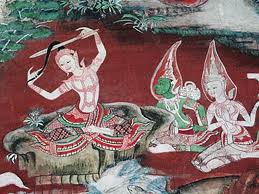
He thought, "These locks of mine are not suited to a monk; but there is no one to cut the hair of a future Buddha. Therefore I will cut them off myself with my sword." And grasping a scimitar with his right hand, he seized his top-knot with his left hand, and cut it off, together with his jeweled turban. His hair thus became two finger-breadths in length, and curling to the right, lay close to his head.

Taking hold of his top-knot and diadem, he threw them into the air, saying: "If I am to become a Buddha, let them stay in the sky; but if not, let them fall to the ground."

They rose into the air for a distance of one league before Vasava (corresponding to the Indra), the chief of gods, perceiving them with his divine eyes, received them in an appropriate jeweled casket, and established them in heaven.

"His hair he cut, so sweet with many pleasant scents, This Chief of men, and high impelled it towards the sky; And there god Vasava, the god with a thousand eyes, In golden casket caught it, bowing low his head."